TEMU


Сет од 5 парчиња заштитник на кабли, прекривка за заштита на кабли од ТПУ, додатоци за заштита на кабли, без батерија, за мобилни телефони, комплет за заштита на податочни линии
54 ден
Is Skopje Drifting Toward the “Serbian World”? A Bulgarian Analysis Raises Alarming Questions
17 декември 2025
• од Goce Kicheski

A recent analysis by Bulgarian journalist Denitsa Kitanova, published by Actualno, draws attention to political and strategic processes in North Macedonia that, according to the author, could have long-term consequences for the country’s European orientation. Kitanova is a parliamentary reporter at Actualno.com and has been part of the outlet’s editorial team since 2022. She has worked in Bulgarian media since 2013 and began covering parliamentary affairs in 2015 as a reporter for the FOCUS News Agency, where her professional interest in developments related to North Macedonia first took shape.
In her analysis, Kitanova argues that while public discussion in North Macedonia has only recently begun to touch upon the sensitive and controversial concept of the so-called “Serbian World,” more substantial political shifts have already been unfolding behind the scenes.
Until 2024, North Macedonia and Albania advanced in parallel on the path toward European Union membership. That trajectory was disrupted when Skopje failed to implement constitutional amendments related to the inclusion of Bulgarians—commitments embedded in the EU negotiation framework. While Albania has since opened all negotiation clusters, the analysis notes that North Macedonia has intensified its political, economic, and strategic ties with Serbia, developments increasingly associated with the doctrine known as the “Serbian World.”
Political Actors and Institutional Dynamics
According to the analysis, a key figure in this process is Deputy Prime Minister Ivan Stoilkovic, who is responsible for inter-community relations and serves as a coalition partner in the government led by VMRO-DPMNE. Kitanova describes Stoilkovic as a highly influential actor within the executive branch, particularly active in strengthening ties with Belgrade.
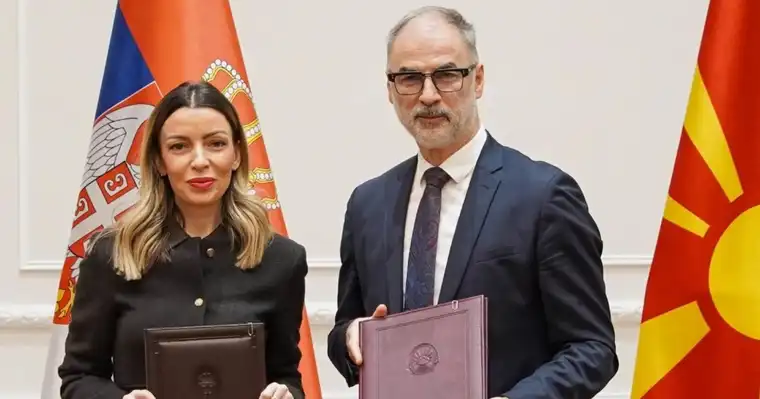
A central example cited is the Memorandum of Understanding signed between the governments of North Macedonia and Serbia by Stoilkovic and Serbian Deputy Prime Minister and Economy Minister Adrijana Mesarović. The document is presented as a step toward deeper economic and strategic cooperation, focusing on trade facilitation, simplified customs procedures, and the removal of barriers, largely within the framework of the “Open Balkans” initiative.
The analysis emphasizes that “Open Balkans” is not recognized by the European Union as an alternative to the EU accession process and carries risks of being used as a geopolitical instrument rather than a mechanism aligned with European integration.
EU Commitments and Regional Orientation
In contrast, relations between North Macedonia and Bulgaria remain burdened by unresolved issues despite the 2017 Treaty of Friendship, Good-Neighbourliness and Cooperation and the 2022 protocol linked to the so-called “French proposal,” which enabled the formal opening of EU negotiations. Key commitments, particularly constitutional changes, remain unfulfilled and are currently under review by the Constitutional Court in Skopje.
Infrastructure cooperation with Bulgaria has shown limited progress, mainly in relation to preparations for the railway tunnel on Corridor VIII. At the same time, comparable infrastructure agreements between North Macedonia and Serbia on Corridor X are cited as further evidence of Skopje’s shifting regional priorities.
High-Level Contacts With Belgrade
Kitanova’s analysis details numerous high-level meetings between Stoilkovic and Serbian officials since the formation of the current government. These include repeated meetings with Serbian President Aleksandar Vučić, encounters with current and former Serbian prime ministers, and multiple meetings with Deputy Prime Minister Mesarović.
The author also highlights Stoilkovic’s role in the opening of a Serbian consulate in Kumanovo, officially intended to promote cultural, educational, economic, and tourism cooperation. At the same time, the analysis notes that public records place a strong emphasis on engagement with Serbian institutions, while other ethnic communities—and particularly Bulgarians—are largely absent from official reporting on his activities.
Historical Context and the “Serbian World” Doctrine
Placing these developments in a broader historical and regional context, the analysis recalls that North Macedonia’s 1991 independence referendum included language that left open the possibility of association with other Yugoslav successor states. According to Kitanova, this ambiguity resonates with contemporary narratives surrounding renewed regional integration under Serbian leadership.
The concept of the “Serbian World,” often compared to earlier ideas of “Greater Serbia,” is described as a modern doctrine aimed at consolidating Serbian political, cultural, and economic influence across the Western Balkans. The analysis links this concept to ongoing tensions and destabilizing trends in Bosnia and Herzegovina, Montenegro, Kosovo, and parts of Croatia.
While a formal restoration of Yugoslavia is widely viewed as unrealistic due to NATO and EU memberships in the region, the analysis concludes that the “Serbian World” may function as a contemporary substitute—one based on influence rather than formal state unification.
Against this backdrop, the author raises the question of whether North Macedonia, amid a stalled EU accession process and deepening ties with Serbia, risks becoming one of the primary testing grounds for such a regional project.
TEMU
Сет од 5 парчиња заштитник на кабли, прекривка за заштита на кабли од ТПУ, додатоци за заштита на кабли, без батерија, за мобилни телефони, комплет за заштита на податочни линии
54 ден
Последни вести
TEMU
Сет од 5 парчиња заштитник на кабли, прекривка за заштита на кабли од ТПУ, додатоци за заштита на кабли, без батерија, за мобилни телефони, комплет за заштита на податочни линии
54 ден
TEMU
Сет од 5 парчиња заштитник на кабли, прекривка за заштита на кабли од ТПУ, додатоци за заштита на кабли, без батерија, за мобилни телефони, комплет за заштита на податочни линии
54 ден
TEMU
Сет од 5 парчиња заштитник на кабли, прекривка за заштита на кабли од ТПУ, додатоци за заштита на кабли, без батерија, за мобилни телефони, комплет за заштита на податочни линии
54 ден
TEMU
Сет од 5 парчиња заштитник на кабли, прекривка за заштита на кабли од ТПУ, додатоци за заштита на кабли, без батерија, за мобилни телефони, комплет за заштита на податочни линии
54 ден
TEMU
Сет од 5 парчиња заштитник на кабли, прекривка за заштита на кабли од ТПУ, додатоци за заштита на кабли, без батерија, за мобилни телефони, комплет за заштита на податочни линии
54 ден
TEMU
Ненадминливи Понуди Дневно
Сет од 5 парчиња заштитник на кабли, прекривка за заштита на кабли од ТПУ, додатоци за заштита на кабли, без батерија, за мобилни телефони, комплет за заштита на податочни линии
4.8 (10276 рецензии)
54 ден
206 ден
Заштедете 152.00 ден